August 2026 server memory roundup
2026-09-10 · 7 min read
Every month this report answers one question: what actually happened to used server RAM prices, with data instead of vibes. This is the first one.
The data is the same pipeline that runs this site. 51 specific eBay searches across the July–August window (70 since the UDIMM slice landed in September), run twice a day until early August and daily since, every listing normalized into an actual spec (stick count, capacity per DIMM, DDR generation, speed, module type), and every listing’s price snapshotted on every run. That’s now 991,118 price observations across 21,816 RAM listings and 127 distinct live spec combinations.
For this report I collapsed it to one observation per listing per month — its last seen price that month — so a listing that sat on eBay for six weeks doesn’t outvote one that appeared twice.
Short version: DDR3 is dead flat, DDR5 kept climbing, and DDR4 — which did nothing all August — woke up hard in the first week of September.
The headline numbers
Median $/GB for single-stick, fixed-price (non-auction) listings:
| Generation | July 2026 | August 2026 | Sept 1–9, 2026 |
|---|---|---|---|
| DDR3 | $3.73 | $3.74 | $3.76 |
| DDR4 | $7.37 | $7.37 | $9.35 |
| DDR5 | $35.05 | $37.48 | $40.79 |
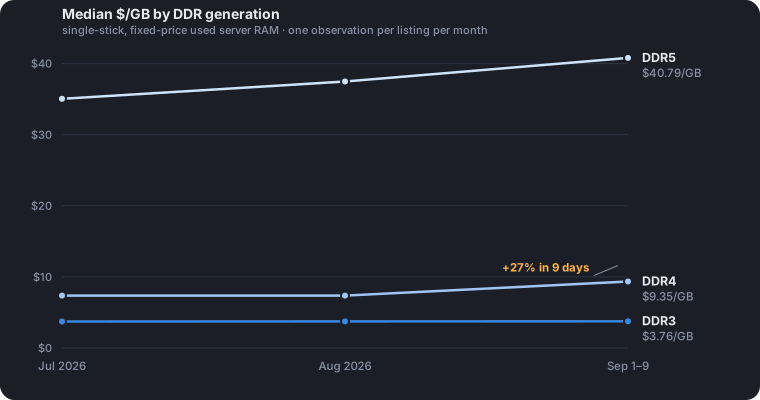
DDR3 has been flat within about 1% for three months, which makes sense: nobody is building anything new around it, and the supply of decommissioned DDR3 is endless. DDR5 is the opposite — up 6.9% across August and another 8.8% in the first days of September. That’s the AI-era memory squeeze showing up in the secondary market, and DDR5 registered server memory is where it’s most visible.
The interesting one is DDR4. It was completely flat through August ($7.369 to $7.366 — a 0.04% move, which is noise), and then jumped 27% in the first week of September. That is not a drift, it’s a step change. When a market sits still for a month and then moves that fast, it usually means buyers who’d been waiting decided to move at once.
[INFERENCE] My read is that DDR4 is getting pulled two directions at once: DDR5 platform costs pushing people to stretch existing DDR4 servers, and the same DRAM supply tightening that’s moving DDR5. I’ll be watching whether September’s step holds or mean-reverts.
Winners and losers by spec
Aggregates hide the real moves. Here’s July → August at the spec level, minimum 15 observations in both months, singles only:
| Spec | July | August | Change |
|---|---|---|---|
| 64GB DDR4-2400 LRDIMM | $3.73 | $5.11 | +37.2% |
| 64GB DDR4-2666 LRDIMM | $3.75 | $4.52 | +20.6% |
| 32GB DDR4-2133 LRDIMM | $3.44 | $4.12 | +19.9% |
| 32GB DDR4-2400 RDIMM | $3.91 | $4.64 | +18.8% |
| 32GB DDR5-5600 RDIMM | $34.75 | $40.59 | +16.8% |
| 16GB DDR4-2133 RDIMM | $4.53 | $4.92 | +8.7% |
| 64GB DDR5-5600 RDIMM | $37.73 | $40.62 | +7.7% |
| 64GB DDR4-2666 RDIMM | $8.05 | $7.86 | −2.3% |
| 32GB DDR4-2666 LRDIMM | $7.83 | $7.46 | −4.6% |
| 16GB DDR4-2400 RDIMM | $6.09 | $5.62 | −7.6% |
| 8GB DDR4-2666 RDIMM | $6.82 | $6.25 | −8.4% |
Two clean patterns:
LRDIMMs are appreciating, and capacity is king. The top of that table is almost all LRDIMM — the load-reduced parts you buy when you’re building maximum-capacity nodes. 64GB DDR4-2400 LRDIMM up 37% in a month is a violent move for used server memory. The fallers are the opposite end: small sticks and older 2666 MT/s parts, with 8GB down 8.4% and 16GB down 7.6%. Density is what’s being bid up; a stick that only gets you 8GB is worth less every month.
DDR5 is up almost across the board. Every DDR5 spec with enough volume to measure rose except one — 128GB DDR5-5600, which slipped 1%.
The real story is the spread, not the median
A median tells you what the market asks. It does not tell you what’s available. Look at how far the floor sits below the middle, for fresh single sticks (16GB+), last 48 hours:
| Generation | Median $/GB | Cheapest $/GB | Floor as % of median |
|---|---|---|---|
| DDR3 | $2.72 | $0.75 | 28% |
| DDR4 | $9.63 | $2.75 | 29% |
| DDR5 | $42.15 | $8.75 | 21% |
There is always something at roughly a fifth to a quarter of the median price. Some of that is junk, misdescribed, or a scam. But not all of it — and the gap is where every actual deal lives.
Now add quantity to it, because this is the thing that started the whole project:
| Listing | $/GB | Ask |
|---|---|---|
| 6× 8GB DDR3-1866 RDIMM | $0.31 | $15.06 |
| 10× 4GB DDR3-1333 RDIMM | $0.35 | $13.78 |
| 5× 8GB DDR3-1333 RDIMM | $0.42 | $16.71 |
| 12× 32GB DDR3-1600 LRDIMM | $0.51 | $195.29 |
| 8× 32GB DDR3-1600 LRDIMM | $0.58 | $148.99 |
Against a DDR3 single-stick median of $2.72/GB, the 6×8GB lot is 8.7× cheaper. Nothing is wrong with it — it’s six working 8GB sticks. It’s invisible because it’s titled as a lot, and eBay sorts by unit price, so the lot never appears at the top of a cheapest-first search.
That is the entire thesis of this site, and the data says it holds every single month.
What changed since the STH thread
I posted DIMMsum + NANDstand on the ServeTheHome forums at the start of September, and the feedback was immediately more useful than anything I’d found testing alone. Worth closing the loop publicly, since these are real fixes:
- Table sorting was broken. luckylinux reported on Sep 1 that you couldn’t even click the table headers — NANDstand’s sorting worked, DIMMsum’s didn’t. Fixed the same day.
- UDIMMs didn’t exist. Sync66 asked for unregistered DIMMs “for AM4 diehards” on Sep 2. That shipped Sep 4, including a proper spec page per speed/capacity combination — for example 16GB DDR4-3200 UDIMM. UDIMMs are a completely different egress lane on the scraping side (they never share an IP with the RDIMM sweep), which is why it wasn’t a one-line change.
- Multi-quantity and variation listings. The original thread flagged several cases where a “lot” or a variation listing was being counted as a single item. Those parse rules are tightened.
- Minimum unit size shipped. luckylinux’s follow-up was the best feature request I’ve gotten, and it’s now live on both sites: a minimum and maximum per-unit filter, so you can say “nothing smaller than 1.92TB” on NANDstand or “32GB sticks only” on DIMMsum. The point being that if you need 1TB of SSD or 32GB of RAM, you don’t care that a pile of 4GB sticks is cheap per GB — and the range matters in both directions, since a 24-bay pool has no use for sub-1.92TB drives while a boot mirror might want exactly those.
If you buy this hardware for a living and something looks wrong, that thread is the best place to tell me.
What’s broken (and why this report has no sold prices)
The framing of this site has always been “asking prices tell you what sellers want, sold prices tell you what buyers paid.” That’s still true. It’s also, right now, unavailable.
The weekly sold-listings harvest broke around July 26. eBay started requiring an account sign-in to view sold/completed items — both direct deep links and the search-then-filter route land on a sign-in wall with an anti-bot challenge. It’s a policy change, not a block I can route around, and the newest sold record in the database is July 18. The harvest timer is disabled rather than silently harvesting zeroes.
So: this report is asking prices only. No sold medians, no ask-vs-sold spread. I’d rather say that plainly than quietly drop the series. Options are a logged-in persistent browser profile (account risk I’m not taking), eBay’s Shopping API (retirement status unclear), or a paid data source. If you’ve solved this, I want to hear how.
What I’m watching for September
- Whether DDR4’s 27% step holds or fades. One week is a signal, not a trend.
- Whether LRDIMM’s premium over RDIMM keeps widening. If capacity buyers are the ones still spending, it will.
- Whether DDR5 keeps climbing at 8% a month, which would make “buy now” the right call for anyone planning a build this quarter.
This report is meant to run once a month with real numbers. There’s a signup box at the bottom of every page if you want it by email. One email a month, data, no other nonsense.
Browse the DDR4 spec pages or the live $/GB scatter. The DDR3 lots are still basically free.